Haunted Places
Haunted Hotels in Savannah, Georgia
Explore Savannah’s most legendary haunted hotels, from historic cotton warehouses to Victorian mansions steeped in centuries of Southern lore.
Beneath the Spanish moss and antebellum ironwork of Savannah, Georgia, lies one of the most layered architectural landscapes in North America. Established in 1733 by General James Oglethorpe, the city weathered devastating fires, repeated yellow fever epidemics, and the upheaval of the American Civil War. Because much of historic Savannah was built atop earlier burial sites and battlegrounds, generations of storytellers have come to view the Hostess City as a threshold where the past never fully recedes.
Today, Savannah’s remarkably preserved historic district allows travelers to do more than admire historic facades from the sidewalk—it invites them to sleep within them. Several of the city’s grandest townhomes, boutique hotels, and former merchant properties have developed enduring reputations for paranormal occurrences. For travelers drawn to Southern Gothic mystery, these historic accommodations offer an unforgettable blend of hospitality and lingering legend.
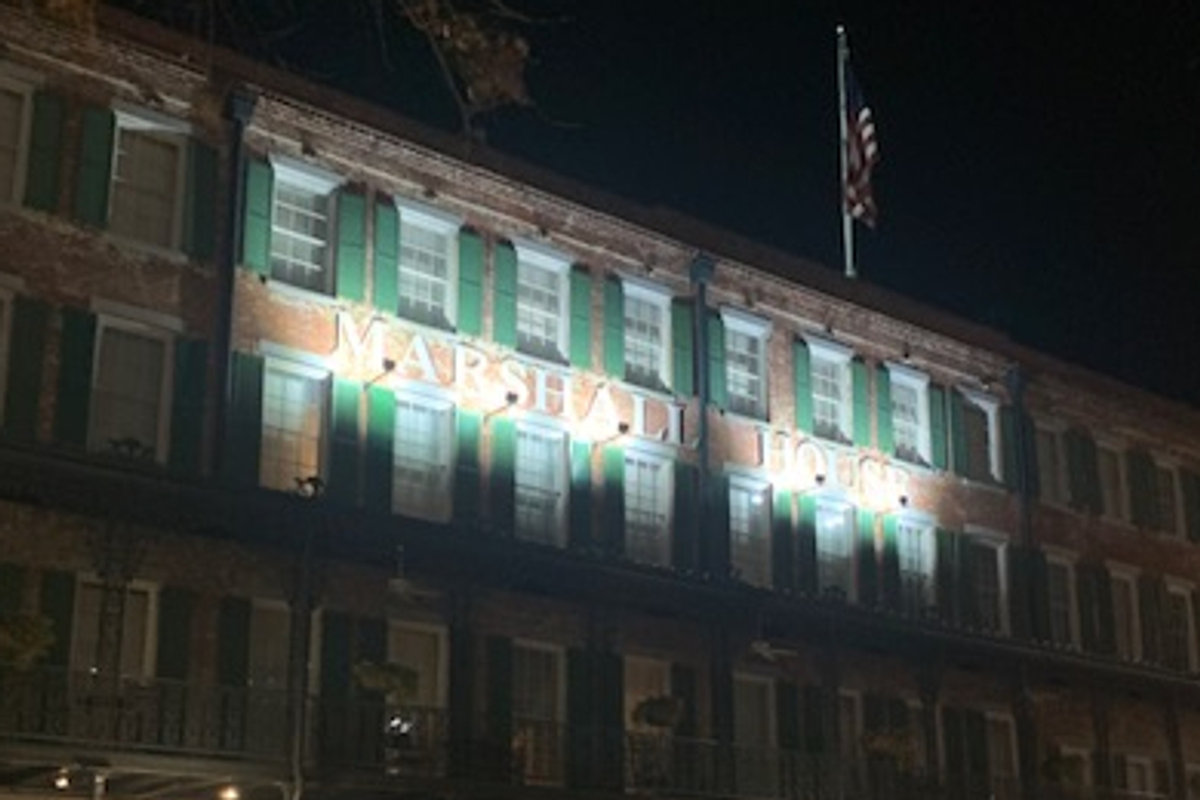
The Marshall House
Built in 1851 by businesswoman Mary Marshall, this Broughton Street landmark is among the oldest operating hotels in Savannah. During the Civil War, the property served as an infirmary for Union troops during General Sherman’s occupation of the city, and it twice served as a hospital during Savannah's yellow fever outbreaks in the nineteenth century. Following a meticulous restoration in the late 1990s, the hotel reopened to modern travelers.
According to enduring local folklore, echoes of the building’s medical past linger throughout its corridors. Guests and staff have reported phantom footsteps in empty hallways, faucets turning on unprompted, and fleeting visions of figures in period nurse uniforms tending to invisible patients. Others describe hearing the sound of children rolling marbles along the wood floors of the fourth floor, long after quiet hours have begun.
The Kehoe House
Commanding the northwest corner of Columbia Square, the Kehoe House was completed in 1892 for prominent iron foundry owner William Kehoe and his large family. Designed in the Queen Anne style by DeWitt Bruyn, the brick mansion features elaborate ornamental cast iron from Kehoe's own foundry. In the mid-twentieth century, the home was converted into a boarding house and later operated as the Goette Funeral Home before returning to service as a luxury bed-and-breakfast.
Over the decades, guests have reported gentle, spectral encounters within its elegant parlors and upper guest rooms. Legend holds that the spirits of children play along the staircases, leaving behind the faint sound of laughter. Visitors staying on the second and third floors occasionally report the distinct fragrance of vintage perfume or pipe smoke drifting through closed rooms, alongside the feeling of an unseen presence lingering by the bedside.
17Hundred90 Inn & Restaurant
Occupying a cluster of historic structures on Lincoln Street, the 17Hundred90 Inn takes its name from the year its foundation was first laid, though the present brick structure primarily dates to the 1820s following the Great Savannah Fire. Over the centuries, the inn has accommodated sailors, merchants, and travelers arriving from the nearby riverfront, preserving its low-beamed ceilings and historic charm.
Local lore associates the inn with a restless spirit named Anne, traditionally said to have resided in Room 204 during the early nineteenth century. Guests booking this room frequently report strange phenomena, from missing personal items reappearing in odd places to the sensation of someone gently adjusting the bedsheets during the night. In the ground-floor restaurant and pub, staff members have long shared tales of Patrick, an unseen presence said to occasionally rattle pots or displace glassware.
The Foley House Inn
Overlooking Chippewa Square, the Foley House Inn was constructed in 1896 for Honoria Foley, the widow of an Irish immigrant. Foley opened the property to travelers, creating Savannah’s first recorded bed-and-breakfast. The inn’s historical narrative took an intriguing turn during a 1989 renovation when workers discovered human skeletal remains concealed behind an interior wall cavity. Forensic analysis confirmed the remains had been hidden there for decades, though the individual’s identity was never established.
This historical discovery fueled decades of local ghost stories. Guests have reported catching glimpses of a shadowy gentleman in late-nineteenth-century attire standing quietly in the courtyard or vanishing near the parlor fireplace. Others describe unexplainable cold spots in the corridors and the faint rustle of clothing passing by in the middle of the night.
River Street Inn
Positioned along the historic river bluff, the River Street Inn occupies a former cotton warehouse built in 1817 from ballast stone and local brick. In Savannah’s prime as a global shipping port, cotton factors inspected, graded, and traded raw cotton in the building’s lower levels before it was loaded onto ocean-bound vessels. The massive building was carefully adapted into a waterfront hotel while retaining its five-story central atrium and exposed industrial timbers.
Given the warehouse's ties to the grueling maritime trade of the nineteenth century, reports of unexplainable occurrences are common. Guests frequently report unexplained temperature drops, flickering electrical fixtures, and the sound of heavy footsteps echoing across the atrium floorboards late at night. Some travelers have described brief sightings of figures dressed in period laborer attire vanishing into corners of the lower levels.
Eliza Thompson House
Located on tranquil Jones Street, often called one of the most picturesque streets in America, the Eliza Thompson House was erected in 1847. Built for Eliza Thompson and her husband, a cotton merchant, the Greek Revival townhouse was celebrated for its elegant entertaining spaces and private carriage house. The property survived the Civil War and the city's turbulent reconstruction era before being restored as an intimate boutique inn.
Staff and guests have shared stories of subtle spectral activity centered around the home's original staircase and formal parlor. Witnesses occasionally report seeing a dignified woman in Victorian mourning dress gazing down into the central courtyard, believed by folklore enthusiasts to be Eliza herself. Others describe the faint strains of classical music drifting through the garden when no sound system is playing.
Hamilton-Turner Inn
Completed in 1873 on Lafayette Square, this French Second Empire mansion was designed for Samuel Pugh Hamilton, a prominent jeweler and former mayor of Savannah. The house achieved historical distinction as the first private residence in Savannah to be equipped with electric lighting. In the twentieth century, the grand home was featured prominently in John Berendt’s best-selling non-fiction portrait of the city, Midnight in the Garden of Good and Evil.
Local legend suggests that Mayor Hamilton’s passion for guarding his residence continues from beyond. Guests occasionally recount seeing the silhouette of a man in late-Victorian clothing pacing the rooftop mansard or smoking a cigar on the veranda, accompanied by the distinct scent of fresh tobacco. Others describe the phantom clicking of billiard balls echoing from rooms that no longer contain gaming tables.
Seeing them for yourself
Many of these historic properties sit within easy walking distance of one another across Savannah's iconic public squares, making them natural highlights for an evening self-guided ghost tour. When exploring these haunted places in Savannah after sunset, always respect hotel guests by admiring facades quietly from the public right-of-way, and remember that city squares and historic cemeteries observe strict evening closing hours.
Hauntings described here are local folklore and reported experiences, not established fact. Always respect private property, posted hours and cemetery rules.