Haunted Places
Most Haunted Places in Charleston, South Carolina
Discover the historic shadows of Charleston, South Carolina, exploring legendary landmarks steeped in centuries of folklore, maritime tragedy, and lingering Southern mystery.
Draped in Spanish moss and illuminated by flickering gas lanterns, Charleston presents one of the most romantic streetscapes in North America. Yet beneath the pastel facades of Rainbow Row and the graceful piazzas of the historic district lies an intricate, often turbulent history spanning more than three centuries. The Holy City has survived sieges, devastating fires, pirate blockades, lethal epidemics, and the deep turmoil of war, each event leaving an indelible mark on its weathered cobblestones.
Over the generations, this convergence of dramatic history and Southern storytelling has fostered one of the nation's richest traditions of ghostlore. Charlestonians do not merely preserve their architectural heritage; they maintain an enduring relationship with the tales of those who walked these streets centuries ago. From subterranean colonial vaults to quiet churchyards shaded by ancient live oaks, the city's supernatural folklore offers an evocative window into its complex past.
The Old City Jail
Constructed on land originally designated as a public square, the Old City Jail operated continuously from 1802 until 1939. Over its long tenure, the fortress-like structure housed an array of inmates, including nineteenth-century pirates, Union officers during the Civil War, petty thieves, and individuals awaiting execution. Living conditions were notoriously grim, marked by severe overcrowding and poor sanitation. Perhaps its most famous occupant was Lavinia Fisher, who, along with her husband John, was imprisoned here in 1819 and executed the following year.
Today, local lore holds that the Old City Jail remains one of the city's most intensely active supernatural landmarks. Tour guests and preservationists have frequently reported feeling sudden, chilling temperature drops in the upper cellblocks. Visitors also describe phantom footsteps pacing the stone floors, unexplained drafts moving through sealed corridors, and glimpses of shadowy figures clad in period dress lingering near the former holding cells.
The Provost Dungeon
Standing proudly at the foot of Broad Street, the Old Exchange and Provost Dungeon was completed in 1771 as a commercial exchange and customs house. During the American Revolution, British occupying forces converted the building’s half-moon battery—originally built in the early 1700s to fortify the harbor against naval attacks—into a military prison. Patriots, privateers, and prominent local citizens were confined in the damp, windowless basement under harsh conditions.
The lower level, now open to museum visitors, carries a reputation steeped in maritime and revolutionary legend. Guests visiting the vaulted brick chamber frequently recount sensations of unease and unexplainable cold spots. According to local guides, reports include the faint sound of clanking chains resonating through the masonry, disembodied murmurs echoing from empty alcoves, and the momentary perception of figures retreating into the darkness of the historic arches.
Unitarian Church Cemetery
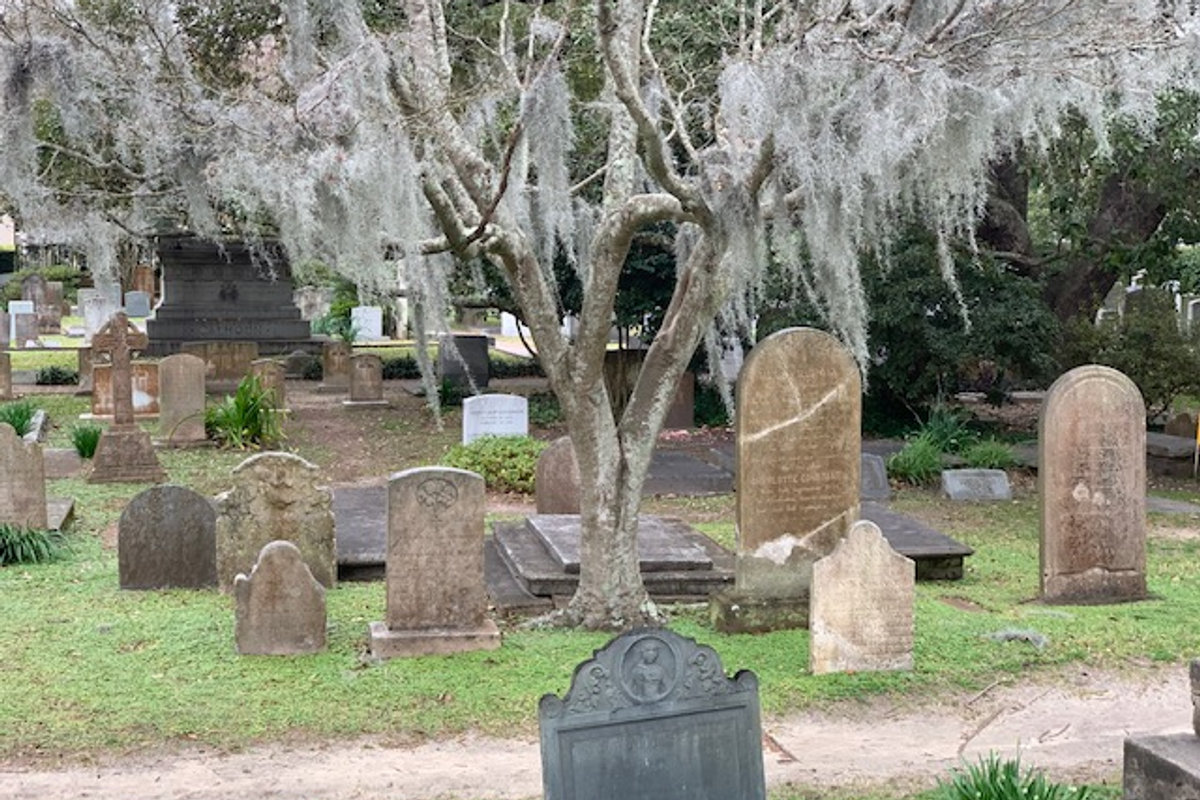
Established in 1772, the Unitarian Church on Archdale Street is the second-oldest congregation in Charleston, surrounded by a famously romantic, partially overgrown churchyard. Unlike manicured municipal cemeteries, this burial ground was intentionally designed in accordance with nineteenth-century Romantic philosophy, allowing native ferns, towering live oaks, and tangled vines to grow in harmony with weathered headstones.
This atmospheric setting has long inspired local ghost stories, most notably the legend of Annabel Lee. Charleston folklore maintains that Edgar Allan Poe’s celebrated final poem was inspired by a real Charleston woman, Anna Ravenel, whose father purportedly forbade her romance with a young soldier stationed at nearby Fort Moultrie. Visitors wandering the cemetery's shell paths at dusk often report an overwhelming sense of melancholia, gentle tugs on their clothing, and fleeting sightings of a lady in a nineteenth-century dress drifting among the camellia bushes.
Poogan's Porch
Located on charming Queen Street, the Victorian home that now houses Poogan's Porch was built in 1888. Before opening as a beloved dining establishment in the 1970s, it served as a private residence, where an elderly schoolteacher named Zoe St. Amand lived out her later years with her sister. Following her sister's death, Zoe reportedly became reclusive, wandering the spacious home in search of her lost companion.
Over the decades, restaurant patrons and staff have documented curious experiences that align with Zoe's story. Diners on the second floor have reported glimpsing an elderly woman in a high-collared black dress stepping into restrooms or gazing out the upstairs windows, only to vanish when approached. Additionally, staff members have noted playful poltergeist phenomena, such as chairs shifting without human touch and barware rattling gently after closing hours.
The Dock Street Theatre
The historic Dock Street Theatre occupies a site that opened in 1736 as the first structure in the American colonies designed exclusively for theatrical performances. After the original playhouse burned, the Planters Hotel was erected on the parcel in 1809, catering to wealthy planters and theatergoers before falling into disrepair after the Civil War. During the 1930s, the building was restored through the Works Progress Administration, reviving its grand stage and historic lobby.
Theatre personnel and theatergoers have long shared legends regarding lingering former patrons. The most prominent reported apparition is Nettie Dickerson, an alleged nineteenth-century clerk who local stories claim fell to her death from an upper balcony during a violent thunderstorm. Visitors describe seeing a translucent figure in a crimson gown walking the second-floor gallery, while actors during rehearsals report sudden cold air drafts and the distinct impression of being watched from the empty shadows of the auditorium.
White Point Garden
Anchoring the southern tip of the historic peninsula, White Point Garden and the adjacent Battery offer expansive views across Charleston Harbor toward Fort Sumter. In the early eighteenth century, however, this picturesque promenade was known as Oyster Point. In 1718, following a bloody naval engagement, the notorious pirate Stede Bonnet, known as the "Gentleman Pirate," and dozens of his crew members were hanged here from makeshift gallows to deter maritime outlaws.
The park's quiet paths and sprawling oak canopies now form a centerpiece of Charleston's nocturnal lore. Late-night strolls under the ancient branches occasionally yield reports of spectral blue lanterns bobbing across the water toward the shore. Visitors have claimed to hear hushed, disembodied voices carried on the sea breeze, and some recount seeing shadowy figures suspended briefly beneath the limbs of the oldest oaks before dissolving into the sea mist.
Circular Congregational Church Graveyard
With origins dating back to 1681, the Circular Congregational Church holds one of the oldest surviving colonial burial grounds in the Lowcountry. The surrounding cemetery on Meeting Street contains hundreds of headstones, including monument markers crafted from slate and Portland stone, some adorned with early American folk motifs like winged death’s heads and weeping willows.
Given the centuries of burials enclosed within this small urban sanctuary, local legends surround its narrow paths. Walking-tour attendees regularly describe anomalous light anomalies appearing near the early eighteenth-century gravestones. Others report sensing sudden, inexplicable pressure in the air, or capturing faint silhouettes in photographs taken after twilight, standing motionlessly amid the crowded, tilted markers before slipping away.
Seeing them for yourself
Many of these historic sites are located within a compact area and can be enjoyed during an evening walk through the historic district. If you decide to explore these storied locations on your own, please remember that Charleston’s cemeteries have strict operating hours and are closed to the public at night. Furthermore, many haunted legends surround private residences and working institutions; always remain on public sidewalks, respect neighborhood quiet hours, and honor the preservation rules that protect this historic coastal city.
Hauntings described here are local folklore and reported experiences, not established fact. Always respect private property, posted hours and cemetery rules.