Haunted Places
Most Haunted Places in San Antonio, Texas
Uncover the storied history and enduring ghost legends of San Antonio, from the battle-scarred Alamo to historic grand hotels along the River Walk.
Few cities in the American Southwest possess a past as layered and turbulent as San Antonio. Long before Spanish Franciscan friars and Canary Island settlers established missions along the river, indigenous peoples thrived in this lush river basin. Over the centuries, the territory weathered Spanish dominion, Mexican independence, the bloody clashes of the Texas Revolution, and the tumult of the Civil War. That depth of human drama has left an indelible mark on the cityscape, where historic Spanish limestone facades now stand framed by the modern skyline.
Beneath San Antonio's vibrant cultural exterior lies one of the nation's most active traditions of ghost lore. The city’s historic core is remarkably compact, allowing visitors to trace the path between legendary battlegrounds, storied grand hotels, and quiet mission courtyards. Whether you are an architectural enthusiast or a seeker of local folklore, exploring the city’s ghostly heritage offers a compelling journey through the human stories that shaped Texas history.
The Alamo
Originally founded in 1718 as Mission San Antonio de Valero, the Alamo is internationally renowned as the site of the pivotal 1836 siege during the Texas Revolution. For thirteen days, Mexican forces surrounded a small band of Texian defenders, culminating in an early morning assault that claimed the lives of nearly all inside the compound, including Davy Crockett and Jim Bowie. Today, the Alamo stands as a solemn historic shrine and museum at the physical heart of downtown San Antonio.
Paranormal folklore surrounding the Alamo dates back to shortly after the battle itself, when Mexican soldiers reportedly refused orders to burn the mission chapel, claiming to see glowing apparitions with flaming swords guarding the threshold. In modern times, park staff and visitors have reported seeing shadowy sentries pacing the outer parapets at twilight and hearing disembodied footsteps moving through the stone sanctuary long after closing.
The Menger Hotel
Opened in 1859 by German immigrant William Menger, this historic hotel sits directly adjacent to Alamo Plaza. It quickly became the premier luxury destination of the frontier, hosting figures such as Sam Houston, Robert E. Lee, and Oscar Wilde. Most famously, Theodore Roosevelt used the dark-paneled Menger Bar to recruit his famed Rough Riders cavalry regiment in 1898. The property retains its original Victorian rotunda, antique furnishings, and Old World atmosphere.
With such a storied past, the Menger is frequently cited by enthusiasts as one of the most active historic hotels in the United States. Guests and staff report sightings of Teddy Roosevelt enjoying an unearthly drink in the bar, along with encounters with Sallie White, an 1870s chambermaid who was tragically killed nearby and whose burial was paid for by the hotel. Visitors describe seeing a polite woman in Victorian-era attire folding laundry or walking silently through the second-floor corridors.
The Emily Morgan Hotel
Standing across the street from the Alamo, the Emily Morgan Hotel occupies a striking 1924 Gothic Revival high-rise adorned with ornate terra-cotta gargoyles depicting various medical ailments. The building originally served as the Medical Arts Building, housing hundreds of doctors' offices, clinics, and a specialized hospital floor with surgical suites and an on-site morgue. It was later repurposed into an upscale hotel, named in honor of the legendary folk hero of the Texas Revolution.
Given its clinical origins, the Emily Morgan has become the focus of extensive modern folklore. Guests staying on the upper levels—formerly the surgical and morgue floors—frequently report inexplicable sensations, including the scent of antiseptics, phantom calls from unoccupied rooms, and elevator cars that drift to specific floors without anyone pushing the buttons. Local lore also holds that translucent figures dressed in nurses' uniforms and white gowns have been glimpsed disappearing into the walls of the hallways.
San Fernando Cathedral
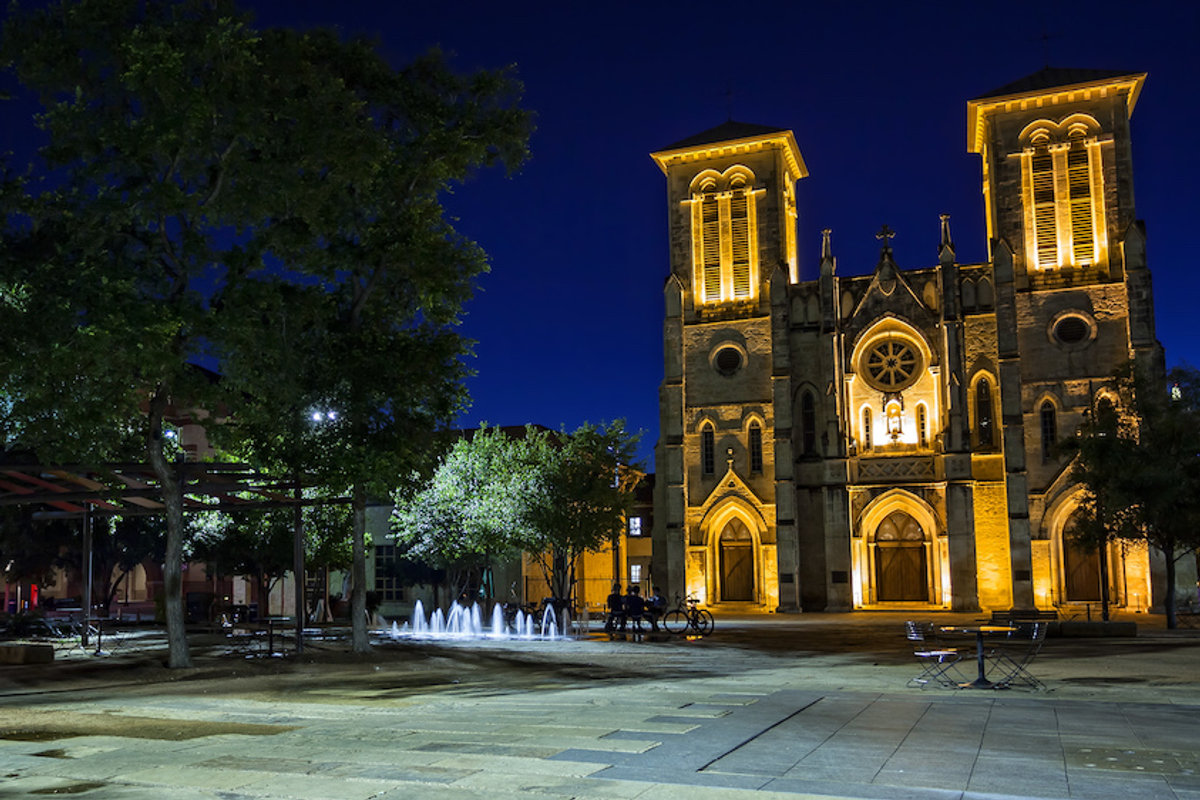
Founded in 1731 by Canary Islander families, San Fernando Cathedral is the oldest continuously functioning religious community in Texas and the civic anchor of Main Plaza. During the 1836 siege, General Santa Anna raised a blood-red flag of "no quarter" from the cathedral’s bell tower. Within its vestibule rests a marble sarcophagus containing the reported remains of Alamo heroes William Travis, Jim Bowie, and David Crockett, whose ashes were recovered after the fall of the garrison.
Over the decades, visitors and parishioners have reported quiet, reverent hauntings inside the vaulted nave. Witnesses claim to have seen shadowy, hooded figures resembling Franciscan friars drifting silently across the altar area during late-night prayer services. Others report capturing unusual mist-like anomalies in photographs of the stone arches or feeling distinct cold spots near the memorial tomb, accompanied by the distant sound of muffled chanting echoing off the centuries-old limestone.
The Spanish Governor's Palace
Constructed in the early 18th century, the Spanish Governor’s Palace is the only surviving aristocratic Spanish colonial residence in Texas. Marked by a carved keystone bearing the Hapsburg coat of arms dated 1749, the building served as both the administrative headquarters and living quarters for the military commanders of the Presidio San Antonio de Béxar. With its thick adobe walls, quiet central patio, and antique period furnishings, it provides an authentic window into colonial frontier life.
Because the presidio grounds were witness to military skirmishes, indigenous conflicts, and formal executions over its long history, folklore abounds within the courtyard. Visitors and museum docents have described feeling sudden, localized chills and an overwhelming sense of being watched while walking through the private chapel and bedrooms. Local legend also tells of a weeping woman in colonial dress who is said to wander near the courtyard fountain, vanishing when approached.
Victoria's Black Swan Inn
Situated along the banks of Salado Creek just northeast of downtown, Victoria's Black Swan Inn sits on land with a storied past. In 1842, the property was the site of the Battle of Salado Creek, a fierce skirmish between the Texian militia and an invading Mexican army. Decades later, a stately Greek Revival plantation home was built on the grounds, which saw its own share of family drama and early twentieth-century tragedies.
Paranormal investigators frequently single out the inn as one of Texas's most intriguing properties. Guests and event attendees regularly recount seeing apparitions of soldiers in nineteenth-century uniforms traversing the sprawling grounds beneath the live oaks. Inside the main house, visitors report moving objects, gentle tugs on clothing, and the apparition of a former matriarch dressed in dark Victorian silk, who reportedly watches over the upper sitting rooms.
The Majestic Theatre
Designed by renowned theater architect John Eberson and opened in 1929, the Majestic Theatre is a breathtaking example of atmospheric theater architecture. Eberson designed the auditorium to resemble a lavish Spanish-Mediterranean village square under an evening sky, complete with artificial cypress trees, classical statues, and a vaulted ceiling studded with twinkling electric stars and projected clouds. It has served generations of San Antonians as a home for vaudeville, cinema, and modern Broadway touring shows.
Backstage hands, performers, and patrons have contributed to a rich tapestry of theatrical ghost stories over the decades. Legend speaks of an apparition known as the "Lady in White," believed to be a former patron who perished in the theater and continues to linger in the upper mezzanine. Others report hearing phantom footsteps crossing the stage late at night, the clinking of vintage drinkware in empty lobbies, and occasional soft applause emanating from dark, unoccupied box seats.
Seeing them for yourself
San Antonio’s historic core is remarkably walkable, making it easy to admire the exterior architecture and soak in the evening atmosphere of places like Alamo Plaza and Main Plaza on your own. If you plan to explore, remember to remain respectful of active hotels, operating performance venues, and sacred places of worship. Always respect private property boundaries, observe posted cemetery and museum hours, and enjoy experiencing the historic beauty of the Alamo City under the stars.
Hauntings described here are local folklore and reported experiences, not established fact. Always respect private property, posted hours and cemetery rules.