Haunted Places
Most Haunted Places in St. Augustine, Florida
Explore the storied, spectral lanes of America's oldest city with this guide to the most historic and haunted places in St. Augustine, Florida.
Founded in 1565 by Spanish admiral Pedro Menéndez de Avilés, St. Augustine is the oldest continuously occupied European-established settlement in the continental United States. More than four centuries of human endeavor have woven a complex tapestry here, marked by colonial ambition, naval sieges, yellow fever epidemics, and shifting imperial boundaries. Long after the flags of Spain, Great Britain, and the United States traded dominance over Matanzas Bay, the city retained its historic footprint: narrow coquina-walled lanes, ancient live oaks draped in Spanish moss, and centuries-old burial grounds tucked quietly behind wrought-iron gates.
With such an extraordinary density of history, it is no surprise that St. Augustine is widely celebrated as one of North America's most paranormally active destinations. The folklore surrounding the Ancient City does not rely on modern fabrications; rather, it is anchored in the well-documented lives, conflicts, and misfortunes of its former residents. Whether walking the stone ramparts along the water or traversing cobblestone avenues beneath the glow of gas lamps, visitors often remark that the boundary between past and present feels remarkably thin.
Castillo de San Marcos
Standing sentinel along the shore of Matanzas Bay, the Castillo de San Marcos is the oldest masonry fortification in the continental United States. Constructed by the Spanish between 1672 and 1695 using porous coquina stone, this bastion successfully weathered multiple British bombardments and remained an active military post under several distinct regimes. Deep within its vaulted casemates lie storage vaults, powder magazines, and unlit confinement rooms once used to hold prisoners of war.
Local legend holds that the fortress remains guarded by those who defended it in life. Park visitors and staff have occasionally reported sighting the spectral figure of a Spanish sentry gazing out across the bay from the upper gun deck before fading into the twilight. Inside the interior chambers, tourists frequently report inexplicable drops in temperature, the lingering scent of sulfur, and the distinct cadence of heavy military bootsteps echoing across empty stone floors.
St. Augustine Lighthouse
Erected in 1874 to replace an earlier Spanish watchtower lost to coastal erosion, the St. Augustine Lighthouse rises 165 feet above Anastasia Island. The surrounding grounds carry a poignant history, most notably marked by an 1873 tragedy in which three young girls—two daughters of construction superintendent Hezekiah Pittee and their playmate—drowned when a supply cart derailed into the adjacent bay during the tower's construction.
Today, the site is known as one of the country's most active historic landmarks. Guests ascending the 219 spiraling cast-iron stairs have reported hearing the distant sound of youthful laughter echoing down the shaft, while others have caught glimpses of small figures along the exterior catwalk. In addition, lingering aromas of vintage pipe tobacco are occasionally noticed in the keeper's quarters, traditionally attributed to keeper Joseph Andreu, who lost his life during an accidental fall from the original tower in 1859.
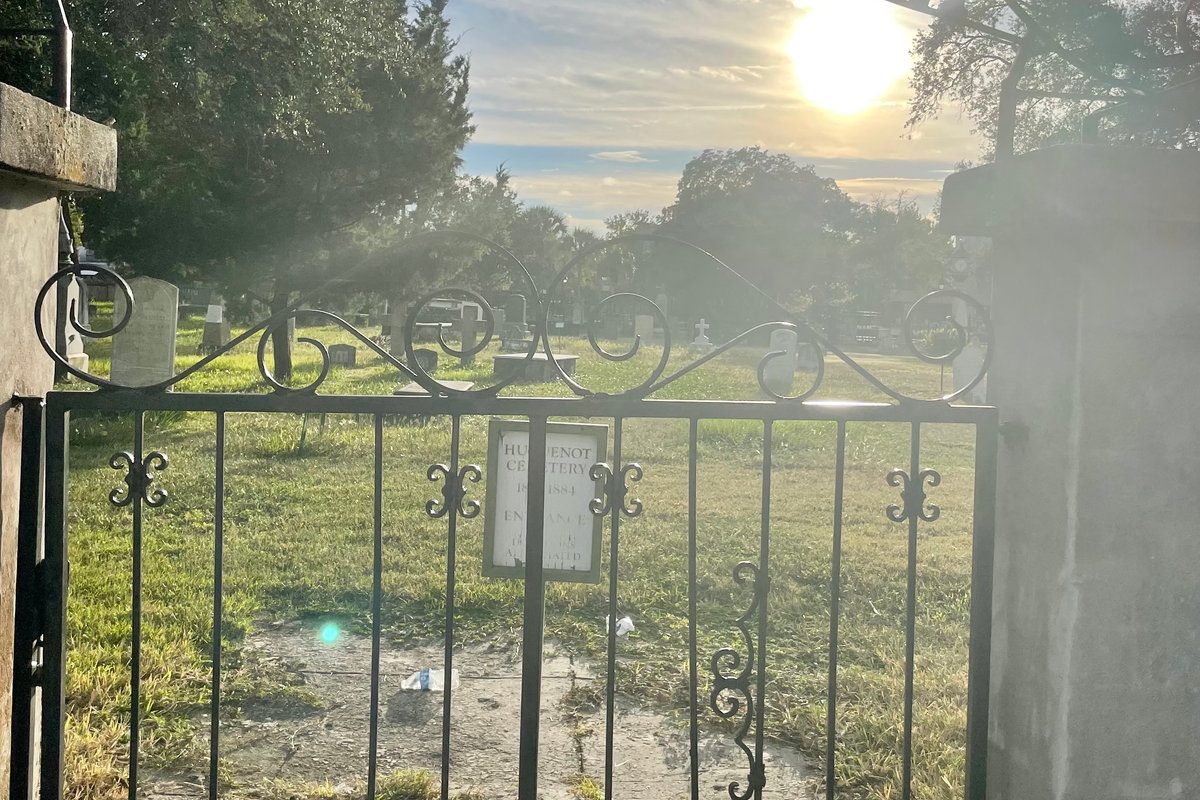
Huguenot Cemetery
Located just outside the historic city gates, the Huguenot Cemetery was dedicated in 1821 during a devastating yellow fever outbreak. Established as the first public Protestant burial ground in a historically Catholic city, the compact parcel served as the final resting place for hundreds of residents who succumbed to illness throughout the nineteenth century before closing to interments in 1884.
Ghost lore surrounding the cemetery frequently features Judge John B. Stickney, a prominent nineteenth-century jurist whose remains were allegedly disturbed during a late-Victorian relocation effort. Observers peering through the perimeter fence after dark have described a tall, translucent figure in Victorian dress gliding gracefully beneath the oak canopy. Passersby also recount seeing faint, drifting orbs of light hover above unmarked plots before disappearing into the evening mist.
Tolomato Cemetery
Situated on Cordova Street, Tolomato Cemetery occupies sacred ground that originally housed a mission village for Christianized Guale Indians during the eighteenth century. Later utilized as a Roman Catholic burial ground until the late nineteenth century, the cemetery contains roughly one thousand burials, including early clergy, prominent civic figures, and minor children.
One of the most persistent legends associated with Tolomato involves a five-year-old boy named James, interred here in the 1870s. Visitors peering through the gates frequently report seeing the silhouette of a young child playing amongst the low-hanging branches of an ancient oak or sitting atop the weathered crypts. Others describe witnessing shadowy figures kneeling in quiet prayer near the cemetery's historic chapel, dissolving as soon as focused light touches them.
The Old Jail
Built in 1891 under the direction of Gilded Age magnate Henry Flagler, the Old St. Johns County Jail was deliberately styled with a Queen Anne Victorian facade so as not to offend the sensibilities of guests staying at his nearby luxury resorts. Behind the pleasant exterior, however, was a secure and Spartan correctional facility that operated until 1953, subjecting inmates to harsh coastal heat, hard labor, and austere conditions.
Tourists and docents routinely describe a heavy, restless atmosphere inside the cellblocks. Reported phenomena include the metallic clatter of non-existent chains, unexplained banging against cell bars, and sudden cold drafts in sealed interior corridors. Several evening visitors have also reported encountering lingering, humanoid shadows in the former maximum-security wing, accompanied by sudden feelings of unease that dissipate only upon exiting the building.
Casablanca Inn
Overlooking Matanzas Bay from the historic bayfront, this Mediterranean-revival property dates to the early twentieth century, when it served as a boarding house. Local folklore tells that during the Prohibition era, the inn's enterprising proprietress aided coastal bootleggers. Legend holds that she watched the harbor for government patrol boats from her upper porch, waving a lantern to signal rumrunners waiting offshore that it was safe to dock.
Now operating as an upscale bed and breakfast, the property has retained its vintage allure along with occasional mysterious occurrences. Guests staying in the upper rooms have reported hearing quiet, deliberate footsteps crossing the veranda in the dead of night. Pedestrians strolling along the bayfront sidewalk after hours have also reported seeing a gentle, amber light swinging rhythmically from the darkened rooftop, echoing the fabled lantern signals of the 1920s.
Spanish Military Hospital Museum
Situated on Aviles Street, the oldest platted street in the country, this museum reconstructed a hospital facility that operated during the Second Spanish Period (1784–1821). The original complex encompassed an apothecary, administrative offices, and recovery wards where Spanish military physicians practiced cutting-edge hygiene and surgical techniques for their era.
Visitors and staff have reported an array of curious experiences within the timbered rooms. Documented accounts mention sudden scents of medicinal herbs and sulfur drifting through areas where none are kept, along with faint moaning and whispers spoken in archaic Spanish. Others have noticed subtle indentations forming on vintage bed linens, as though an invisible patient had just rested upon the mattress.
Seeing them for yourself
Because St. Augustine's historic core is remarkably compact and walkable, visitors can comfortably view many of these exterior landmarks on a self-guided evening stroll. The gentle sea breezes and ambient street lamps create an unforgettable setting for exploring local folklore. When touring, please remember that historic cemeteries have strict closing hours and must be viewed only from outside their perimeter gates. Always respect private properties, stay on public sidewalks, and enjoy the rich heritage of America's oldest city with courtesy and care.
Hauntings described here are local folklore and reported experiences, not established fact. Always respect private property, posted hours and cemetery rules.