Indiana
Ghost Tours in New Harmony
Self-guided haunted tours, ghost walks and dark history in New Harmony, IN — explore at your own pace, any night you like.
Perched along the winding banks of the Wabash River, New Harmony, Indiana, is one of the most unusual and tranquil towns in the American Midwest. Known worldwide as the site of two nineteenth-century utopian experiments, the village radiates a deliberate, quiet beauty lined with brick paths, towering goldenrain trees, and remarkably preserved architecture. Beneath this peaceful exterior, however, lies an enduring tradition of ghost stories, unexplained occurrences, and lingering echoes of the seekers who once dreamed of building heaven on earth.
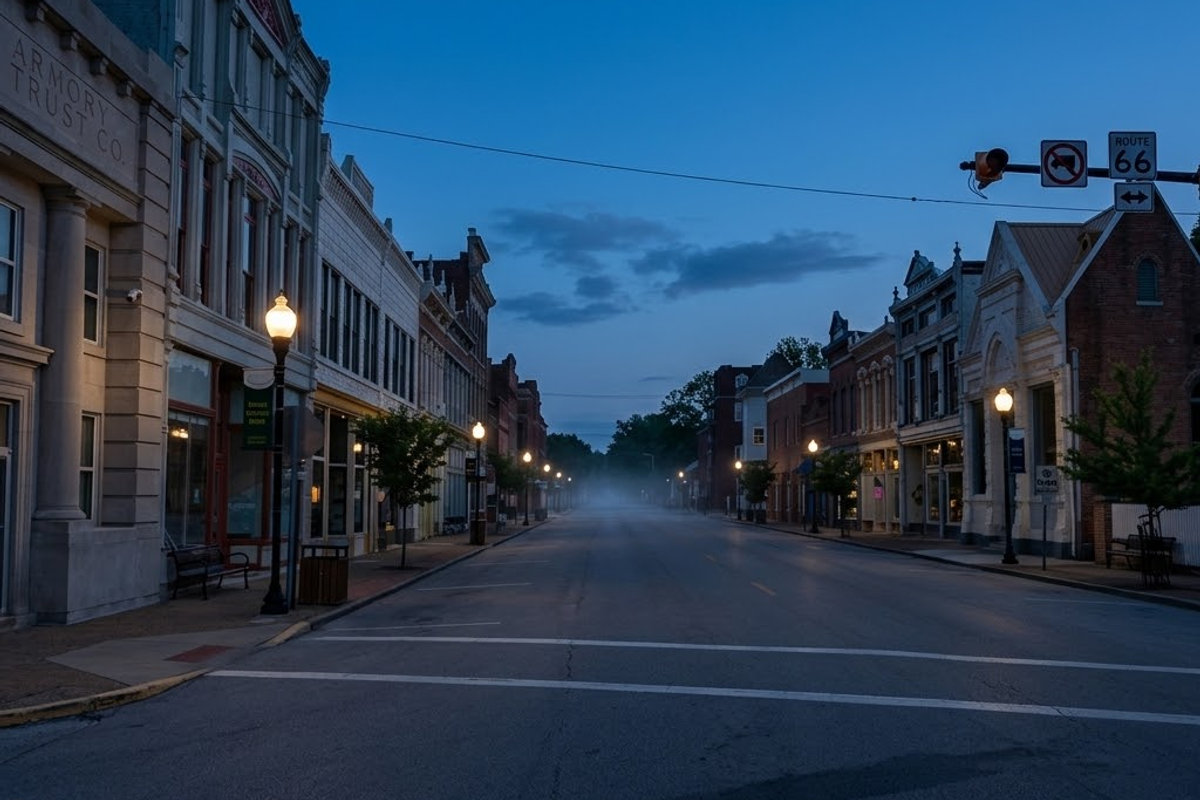
Exploring New Harmony after twilight offers an entirely different perspective on its storied past. With the self-guided New Harmony Ghosts Walking Tour, visitors can delve into town lore on their own schedule without being hurried along by a large crowd. As you navigate the shadowed avenues, your smartphone acts as your personal storyteller, leading you from one eerie landmark to the next while recounting the legends that have circulated among residents for generations.
Your route introduces you to the town's most storied locations, including the historic Fauntleroy Home, the preserved David Lenz House and Garden, and the grounds of the Roofless Church, where hundreds of early settlers rest in unmarked graves. You will also pass beloved local landmarks like the Red Geranium, the historic Thrall’s Opera House, the sprawling Ribeyre Center, and the venerable Working Men’s Institute. Whether you are fascinated by frontier spiritualism, communitarian history, or classic ghost lore, walking through New Harmony under the stars reveals a captivating world where the boundary between past and present feels remarkably thin.
Haunted tours in New Harmony (1)
New Harmony ghost tour map
Approximate starting locations for each tour in New Harmony.
The Utopian Dreams and Ghostly Echoes of New Harmony
The spectral reputation of New Harmony is inextricably tied to the two communal societies that shaped its soil. In 1814, German Separatists known as the Harmonists, led by the charismatic mystic George Rapp, carved a thriving town out of the Indiana wilderness. Believing the second coming of Christ was imminent, the Harmonists practiced strict celibacy, communal ownership, and rigorous physical labor. When members died, they were buried in an orchard cemetery without markers or headstones, ensuring complete spiritual equality even in death. Today, a brick wall constructed from recycled Harmonist bricks encloses these unmarked resting places near the modern Roofless Church. Visitors often report a profound, heavy quiet in this area, while local lore speaks of shadowy figures seen gliding across the perimeter beneath the canopy of trees.
By 1825, Rapp had sold the town to Welsh industrialist and social reformer Robert Owen, who sought to create a secular "Community of Equality." Owen’s vision drew scholars, scientists, and free-thinkers from around the globe, but ideological friction dissolved the formal community within a few short years. What remained was a dense concentration of intellect, eccentricity, and tragedy. Settlers fell victim to harsh winters, river ailments, and sudden accidents, leaving their memories etched into the sturdy brick and timber structures they left behind.
Among the town’s most reported paranormal sites is Thrall’s Opera House, originally constructed as a communal Harmonist dormitory before being transformed into a vibrant nineteenth-century theater. Performers and caretakers over the decades have claimed to hear disembodied footsteps crossing the wooden stage, murmuring voices from empty wings, and the faint rustle of phantom attire. Just down the street stands the Fauntleroy Home, a cradle of early progressive social clubs, where witnesses have described unexplained cold spots, closing doors, and the fleeting silhouette of a woman dressed in vintage clothing gazing out from an upper window.
At the David Lenz House, an authentic single-family Harmonist dwelling, visitors occasionally sense a watchful presence in the modest rooms. Similar accounts surround the Working Men’s Institute—Indiana's oldest continuously operating public library—where late-night staff have reported books shifting position and quiet footsteps pacing the historical archives. Even gathering places like the Red Geranium and the Ribeyre Center have collected tales of flickering lights and inexplicable drafts. In New Harmony, where utopian aspirations met human fragility, the past has never truly departed.
Haunted Stories & Guides
Salem Ghost Stories and the History Behind Them
Explore Salem’s haunted reputation through the Witch House, Ropes Mansion and Giles Corey, with history distinguished from ghost lore.
 Cemeteries
15 Haunted Cemeteries in America and the Ghost Stories Behind Them
From New Orleans' cities of tombs to a Salem burial ground older than the witch trials: fifteen American cemeteries worth visiting in daylight — who's buried there, what's documented, and what's legend.
 Haunted Towns
13 Haunted Towns in America for a Spooky Weekend Trip
Small towns where the whole place seems in on the story: thirteen walkable American towns with genuinely dark histories, atmospheric main streets, and a self-guided ghost tour you can start whenever the sun goes down.