Haunted Places
Most Haunted Places in New Orleans, Louisiana
Explore the historic French Quarter and beyond with this atmospheric guide to the most legendary haunted places across New Orleans.
Few cities in North America carry the atmospheric weight of New Orleans. Beneath a canopy of live oaks draped in Spanish moss, the Crescent City balances Old World charm with an undercurrent of untamed mystery. Century-old gas lanterns flicker against pastel Creole townhouses, wrought-iron balconies cast intricate shadows over cobblestones, and the humid subtropical air seems to hold onto memories long after the living have moved on.
Founded in 1718, New Orleans has endured devastating fires, yellow fever epidemics, wars, and catastrophic storms. This layered, tumultuous past has nurtured a folklore unlike anywhere else in the United States. From the quiet recesses of the French Quarter to the whitewashed vaults of its historic burial grounds, the city’s past and present exist in constant conversation. Whether you are a dedicated paranormal enthusiast or simply a lover of folklore, these documented sites showcase why New Orleans is regarded as one of the world's most storied spectral destinations.
The LaLaurie Mansion
Dominating the corner of Royal and Gov. Nicholls streets, the LaLaurie Mansion is perhaps the most notorious private residence in New Orleans. Built in the early 1830s for the prominent socialite Madame Marie Delphine LaLaurie and her husband, the three-story home was an epicenter of French Quarter society until an 1834 kitchen fire led to the public exposure of severe cruelties committed within the house. The enraged populace drove Madame LaLaurie from the city, and the structure later served variously as a public school, an apartment building, and a private residence.
Because of its grim past, the property has accrued decades of chilling folklore. Passersby along Royal Street frequently report sudden, unnatural drops in temperature near the exterior walls, while neighbors have claimed to see phantom apparitions pacing the top-floor balconies at dusk. Though the residence remains a private home closed to tours, its towering facade remains an essential, somber stop for any visitor tracing the darker chapters of French Quarter lore.
St. Louis Cemetery No. 1
Established by Spanish royal decree in 1789, St. Louis Cemetery No. 1 is the oldest extant burial ground in New Orleans. Because the city’s high water table precluded deep subterranean burials, locals built elaborate above-ground brick and marble vaults, earning the cemetery the moniker "City of the Dead." Among the illustrious figures interred within its maze of whitewashed tombs is Marie Laveau, the revered 19th-century Voodoo practitioner whose cultural influence still resonates across the region.
Decades of reports describe strange occurrences along the cemetery's narrow shell paths. Visitors have reported glimpsing the ethereal silhouette of a tall woman in a traditional Creole headwrap vanishing behind marble vaults, as well as the disoriented spirit of a nineteenth-century sailor wandering among the crypts. Due to preservation initiatives and historic vandalism, the cemetery is accessible only via licensed guided tours, preserving the solemn dignity of its eternal residents.
Muriel's Jackson Square
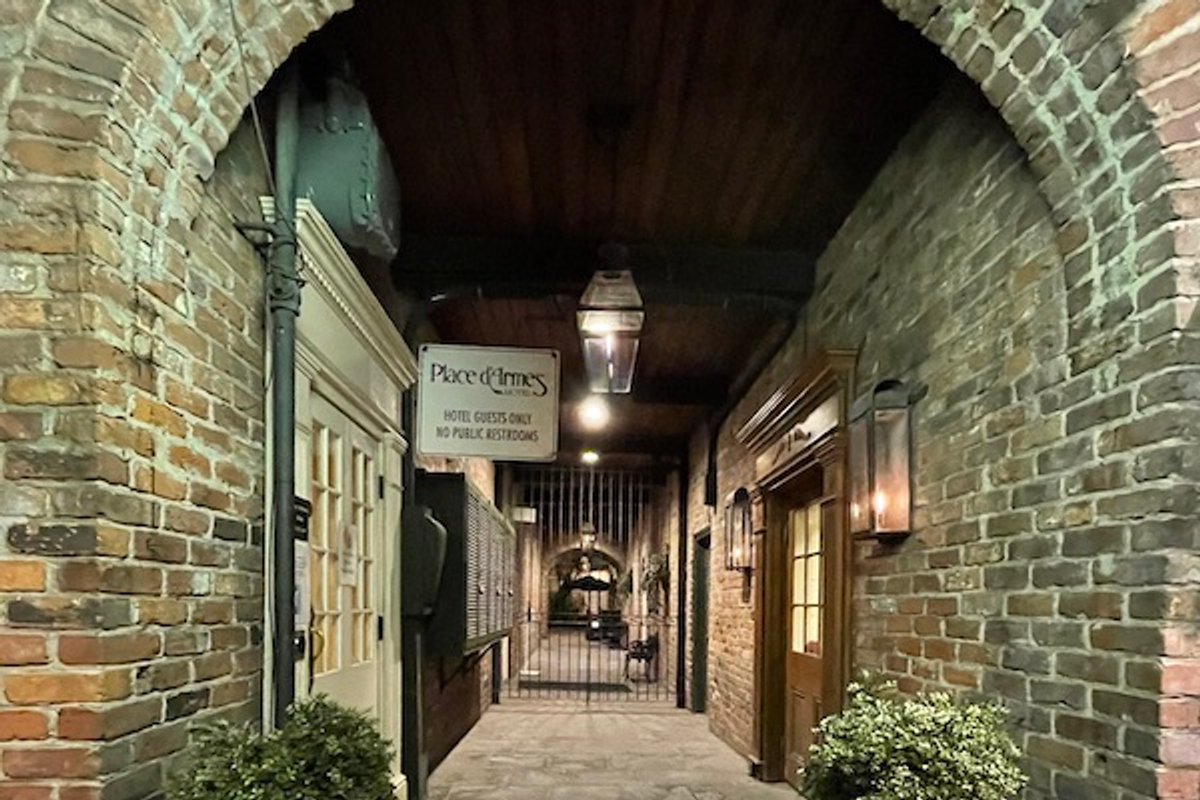
Perched just off the historic Place d'Armes, the building housing Muriel's Jackson Square dates back to the reconstruction that followed the Great New Orleans Fire of 1788. Pierre Antoine Lepardi Jourdan purchased and restored the property into a lavish family residence. However, in 1814, after allegedly wagering his beloved home in an all-night poker game and losing, Jourdan took his own life on the mansion's second floor before formally surrendering the deed.
Today, the second floor serves as the restaurant’s lounge, where patrons report glasses gently sliding across tables, unexpected cold breezes, and shadowy outlines near the brick archways. Embracing its resident specter, Muriel’s maintains a small table set nightly with wine and bread reserved exclusively for Jourdan’s spirit, blending traditional Creole hospitality with one of the Quarter's best-loved ghost stories.
Hotel Monteleone
Since opening its doors in 1886, the Hotel Monteleone on Royal Street has stood as a beacon of luxury and literary heritage, hosting luminaries such as William Faulkner, Ernest Hemingway, and Truman Capote. Yet alongside its reputation for opulence and its world-famous rotating Carousel Bar, the grand hotel carries a long record of inexplicable phenomena reported by both guests and staff.
According to local legend, the hotel is home to several playful spirits, most notably a young boy named Maurice Begere, whose family stayed at the hotel in the late 19th century. Guests staying on the higher floors frequently recount encounters with an elevator that allegedly stops at unselected floors, revealing chilly, deserted hallways where a child's laughter faintly echoes. Others have witnessed service doors swinging open and locking autonomously in the quiet early morning hours.
The Gardette-LePrête House (The Sultan’s Palace)
Located on Dauphine Street, this stately Greek Revival townhouse was erected in the 1830s for dentist Joseph Coulon Gardette. Decades later, the property was leased to a wealthy, enigmatic gentleman who claimed to be the brother of a foreign sultan. According to local lore, the tenant filled the home with opulent furnishings, guards, and a lavish entourage, living in secluded luxury until an infamous night when a mysterious tragedy reportedly wiped out the entire household.
While historical records debate the exact details of the dramatic legend, the house has earned a permanent place in local folklore. Neighbors and nighttime strollers report catching the faint, unexpected scent of incense and exotic spices drifting from the iron galleries, accompanied by the muffled sounds of distant music and shadowy silhouettes standing motionless behind the upper French doors.
The Andrew Jackson Hotel
Occupying an intimate stretch of Royal Street, the Andrew Jackson Hotel sits on land steeped in civic history. In the late 18th century, the site housed a colonial boys' boarding school, and later, a federal courthouse where General Andrew Jackson was famously held in contempt of court during the War of 1812. The present brick townhouse was constructed in 1890 and eventually transformed into a boutique hotel.
Guests consistently describe encounters with mischievous spirits here. Legend holds that the ghosts of several schoolboys still linger on the grounds; visitors have reported waking to the sensation of someone tugging at their bed coverings or hearing the distinct sounds of children laughing in the courtyard in the dead of night. Others claim to have felt an authoritative, watchful presence in the front corridors, often attributed to the general himself.
Faulkner House Books
Tucked down quiet Pirate's Alley alongside the soaring spires of St. Louis Cathedral, this handsome four-story townhouse was where a young William Faulkner rented rooms in 1925. It was in this very building that Faulkner penned his first published novel, Soldiers' Pay, while immersing himself in the vibrant bohemian culture of the French Quarter.
Today, the ground floor operates as an acclaimed independent bookstore. Literary pilgrims and staff members have noted the distinct, unmistakable scent of aromatic pipe tobacco lingering in rooms where smoking has long been banned. Some visitors browsing the tall wooden shelves report catching sight of an apparition dressed in vintage tweed seated quietly at a writing desk in the back corner, disappearing the moment a curious reader looks twice.
Seeing them for yourself
Many of these storied landmarks are situated within comfortable walking distance of one another, making it easy to embark on a self-guided evening walking tour through the gaslit corridors of the French Quarter. While taking in the eerie ambiance, remember that several of these historic locations are active private homes or operational businesses. Always remain on public sidewalks, avoid disturbing quiet residential neighborhoods after dark, and note that historic cemeteries strictly require official guided access and enforce rigid closing hours.
Hauntings described here are local folklore and reported experiences, not established fact. Always respect private property, posted hours and cemetery rules.